Why Did Leonardo da Vinci Leave So Many Paintings Unfinished?

Leonardo da Vinci is often imagined as the ultimate Renaissance genius: an artist who could see further than everyone around him, combining painting, science, anatomy and engineering in a way that still seems extraordinary today.
Yet there is something strangely incomplete about his artistic legacy.
Some of Leonardo’s most famous works were never finished.
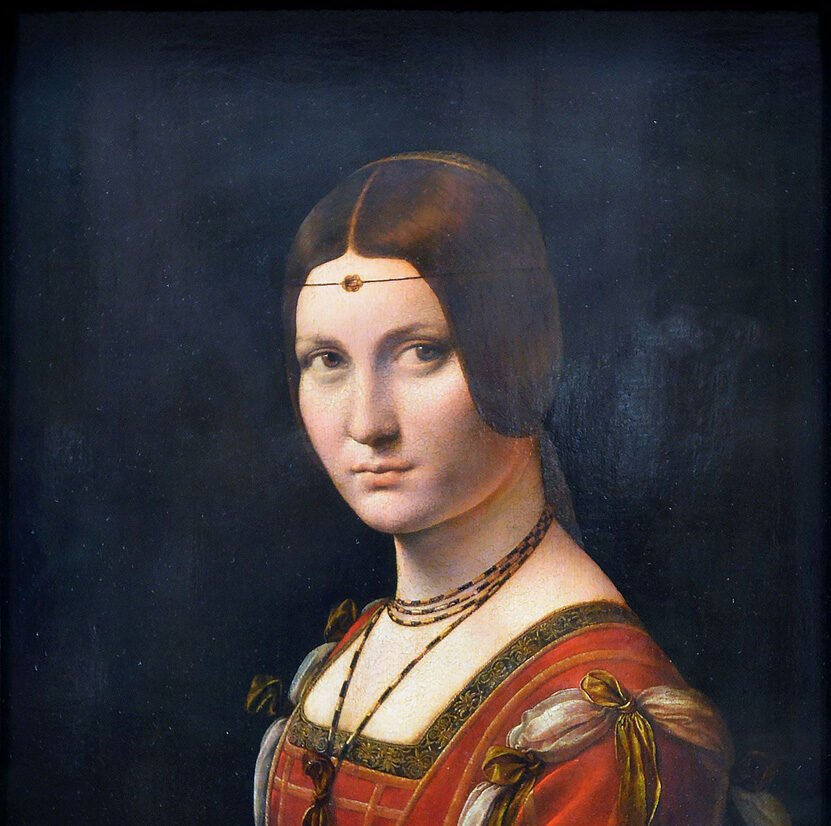
The Adoration of the Magi was abandoned. Saint Jerome in the Wilderness remained incomplete. The Virgin and Child with Saint Anne was worked on for years and still contains areas that seem unresolved. Even the Mona Lisa, although highly finished compared with his other works, appears to have occupied Leonardo for an extraordinary length of time.
So why did one of history’s greatest artists struggle to finish his paintings?
The simplest explanation is that Leonardo was a perfectionist.
But that doesn’t quite explain what was happening.
Leonardo approached painting almost like an investigation into nature. He wasn’t satisfied with simply knowing what a person looked like. He wanted to understand why they looked that way.
He studied anatomy so that he could understand the structure beneath the skin. He observed how muscles moved, how light behaved, how water flowed and how shadows softened across surfaces. He filled notebooks with observations and drawings, constantly trying to understand the physical world around him.
For Leonardo, painting wasn’t merely about reproducing appearances.
It was about understanding reality.
And that created a problem.
The more he observed, the more complicated the world became.
A face was no longer simply a collection of features. It was the result of muscles, bones, expressions, light, age and emotion. A hand wasn’t merely something to draw—it was an intricate mechanical structure capable of an astonishing range of movement.
Leonardo’s curiosity could therefore become almost paralysing.
He could begin a painting with one intention and then become fascinated by another problem halfway through.
Perhaps he wanted to understand how the light fell across a figure. Then he became interested in the anatomy beneath the figure’s clothing. Then he experimented with the expression on the face. Each discovery opened another question.
The painting became an experiment.
And experiments don’t always have convenient endings.
This helps explain one of the strangest things about Leonardo’s surviving works: some areas appear extraordinarily refined while others remain barely developed.
His Saint Jerome in the Wilderness, for example, gives us a haunting glimpse of an unfinished masterpiece. Jerome’s body and face are carefully developed, while much of the surrounding composition remains incomplete.
Yet the unfinished quality somehow makes the painting more fascinating.
You can almost see Leonardo thinking.
There is another important reason for his unfinished works: Leonardo was notoriously difficult when it came to commissions.
Renaissance artists were often employed to complete specific works for churches, wealthy families and powerful patrons. Finishing a commission was therefore not simply an artistic matter. It was a professional obligation.
Leonardo, however, had a tendency to become distracted by new ideas.
His interests extended far beyond painting. He investigated flying machines, weapons, architecture, anatomy, geology, water systems and countless other subjects.
He could spend years exploring questions that had nothing directly to do with the commission sitting in front of him.
This sounds like extraordinary genius—but it could also be extraordinarily inconvenient.
Leonardo’s mind constantly moved forward.
Perhaps the most famous example is the Mona Lisa.
Leonardo is believed to have worked on the portrait for many years, carrying it with him rather than simply handing it over to its presumed commissioner. He continued modifying it long after the initial portrait would presumably have been recognisable as finished.
Why?
Because for Leonardo, there may not have been a clear moment when a painting became absolutely perfect.
There was always another subtle improvement to make.
A softer transition between light and shadow.
A slightly more convincing expression.
A more natural relationship between figure and landscape.
Leonardo’s famous technique of sfumato—the extremely subtle blending of tones that makes forms appear to emerge gradually from light and shadow—was perfectly suited to this obsession.
There are no harsh boundaries.
Everything seems to dissolve into everything else.
The result can feel almost alive.
But achieving that effect required enormous patience.
Leonardo’s paintings therefore seem to occupy an unusual position between art and observation. They aren’t simply pictures of things. They are attempts to understand how things exist.
And this may be why his unfinished paintings are so revealing.
An unfinished Leonardo does not necessarily look like a failed Leonardo.
Instead, it can look like a window into the process of thought itself.
We are accustomed to seeing great artworks as finished objects. They hang in museums, protected behind glass, surrounded by historical information that makes them seem almost untouchable.
But Leonardo’s unfinished works remind us that masterpieces begin as uncertain experiments.
There was a moment before the famous painting existed when Leonardo was simply standing in front of a surface, trying to work out what to do.
Perhaps this is the most fascinating thing about his unfinished paintings.
They show us that genius is not necessarily the ability to know the answer immediately.
Sometimes it is the inability to stop asking questions.
Leonardo wanted to understand too much.
He wanted to understand the human body, the movement of water, the flight of birds, the structure of the earth and the behaviour of light. Painting became one of the ways through which he investigated those mysteries.
And when the questions became more interesting than the commission itself, the painting could remain unfinished.
That may be frustrating from the perspective of a patron waiting for their masterpiece.
But from our perspective, centuries later, it gives Leonardo’s work an unusual intimacy.
We don’t only see the paintings he completed.
We see the paintings he was still trying to understand.
And perhaps that is why his unfinished masterpieces remain so compelling.
They don’t merely show us what Leonardo could do.
They show us how his mind worked.
By Impetus